How Many Calories to Lose Weight? Build a Deficit You Can Keep
A plain guide to the calorie deficit: how to estimate your maintenance calories, choose a safe target, and set a daily budget you can actually stick to.
Weight loss has one non-negotiable requirement. Over time, you have to take in less energy than you spend. Everything else, the food choices, the timing, the macros, is a way to make that one thing bearable.
That energy gap has a name. A calorie deficit.
So how many calories should you eat to lose weight? There is no single number that fits everyone, but there is a simple way to find yours: estimate what your body burns in a day, then eat a little less than that. The rest of this guide walks through each step, the size of deficit that tends to last, and the mistakes that quietly stall progress.
Four numbers, one daily budget
A deficit is built, not guessed.
- 1The baseline
Resting burn
What your body uses at rest
- 2Your maintenance
Add movement
Daily activity, not workouts to spend back
- 3The lever
Subtract a little
Around 550 fewer calories a day
- 4What you eat
Your daily budget
The number you spend down, never below a floor
Start with what your body already burns
Before you subtract anything, you need a starting point: the number of calories your body spends on an average day. That figure is your maintenance level, often called Total Daily Energy Expenditure, or TDEE.
It has two parts.
The first is the energy you would burn doing nothing at all, lying still all day. That is your Basal Metabolic Rate, or BMR, and it usually accounts for most of what you spend. The most common way to estimate it is the Mifflin-St Jeor equation, which uses your height, weight, age, and sex.
The second part is movement: walking, standing, fidgeting, and any exercise. To account for it, your BMR is multiplied by an activity factor, from roughly 1.2 for a mostly seated day up to about 1.55 for a consistently active one.
Put together, the maintenance estimate looks like this:
Maintenance calories = your resting burn, multiplied by how active your days are.
The word to hold onto is estimate. Equations like Mifflin-St Jeor were built to be close on average, not exact for any one person.
That is why you should treat your first maintenance number as a hypothesis. It gives you a place to begin. Your real intake and your weight trend over a few weeks will tell you whether it was close.
Turn maintenance into a deficit
Once you have a maintenance estimate, a deficit is just maintenance minus a bit. The size of that bit decides how fast you lose and how hard the process feels.
A useful reference point: roughly 7,700 calories is stored in about one kilogram of body mass. Spread across a week, that means:
- A cut of about 550 calories a day points toward losing around half a kilogram a week.
- A cut of about 275 calories a day points toward roughly a quarter of a kilogram a week.
- A cut of about 1,100 calories a day points toward roughly a kilogram a week.
Bigger deficit, harder to hold.
A faster pace asks for a larger daily cut. The middle row is usually the one people can keep.
The faster paces look tempting on paper. In practice, a larger daily cut means more hunger, less energy, and a plan that is harder to hold for months. Most people do better choosing a pace they can barely notice at dinner than one they fight all day.
There is also a floor worth respecting. Cutting calories very low does not speed things up in a way that lasts; it usually just makes the plan miserable and short. A sensible plan keeps a sane minimum, which is why Tek never sets a daily budget below 1,500 calories, whatever the math would otherwise suggest.
The 3,500-calorie rule is a rough guide, not a law
You may have read that a pound of fat is 3,500 calories, so a 500-calorie daily deficit means a pound a week, forever. It is a handy starting estimate. It is also not quite how bodies work.
As you lose weight, you get lighter, and a lighter body burns fewer calories. The same deficit that dropped a pound in week one does a little less by month three. Progress that appears to slow is often the math catching up, not a failure of willpower.
The practical takeaway is not to abandon the deficit. It is to expect the pace to ease, to judge progress over weeks rather than days, and to adjust your budget when the trend genuinely flattens rather than the moment the scale has a bad morning.
Do not eat your workouts back
Here is where a lot of tracking quietly goes wrong. You do a workout, an app or watch says you burned 500 calories, and you add those calories back to your food budget for the day.
Two problems. First, exercise-calorie estimates are notoriously generous, often high by a wide margin. Second, adding them back turns exercise into a reason to eat more, which erases much of the deficit you were trying to build.
This is a deliberate design choice in Tek: your daily budget is the number, and food spends it down. Movement is already accounted for in your activity level when the budget is set. There is no separate exercise credit to earn and eat, because that loop is the fastest way to stall without knowing why.
Let exercise do its real jobs, protecting muscle, mood, and health, and let the deficit come from your intake.
Protein helps, but calories decide
The internet loves arguing about macros. Low carb, low fat, high protein, and so on. For fat loss specifically, the honest summary is calmer than the debate suggests: the calorie total is what drives loss, and the macro split mostly changes how comfortable the deficit feels.
That said, two macro habits genuinely help while you are in a deficit:
- Protein. Enough protein helps preserve muscle and keeps you fuller on fewer calories. A common target is somewhere near 1.6 to 2 grams per kilogram of bodyweight. Tek plans around the upper part of that range for the same reason. For a concrete example of hitting a protein target while eating out, see how to build a high-protein Chipotle bowl. If a GLP-1 medication is producing your deficit for you, protein becomes the number to track rather than a supporting one, which we cover in tracking food on a GLP-1.
- Fat and carbs. Once protein is set, the remaining calories split between fat and carbs is largely personal preference. Pick the balance you can live with. The best split is the one that keeps you on plan.
So track calories first. Use protein as a supporting target. Do not let a macro argument distract you from the number that actually moves the scale.
Make the budget something you can see
A deficit only works if you can tell whether you are inside it. That means your daily budget has to be visible, and each meal has to be quick to log and easy to correct.
This is the whole point of a daily calorie budget as a mental model. One number to spend down. Meals subtract from it. A photo or a barcode gets a meal into the log in seconds, and the estimate stays editable so you can fix the portions that matter.
Designed for correction, not blind trust
Tek shows the foods behind the number.
Review each item, change a portion, add a missing sauce, then return to one calm daily budget. The estimate starts the log. You finish it.
- Itemized foods and portions
- USDA grounding when available
- Plain-language fixes
- Every estimate stays editable
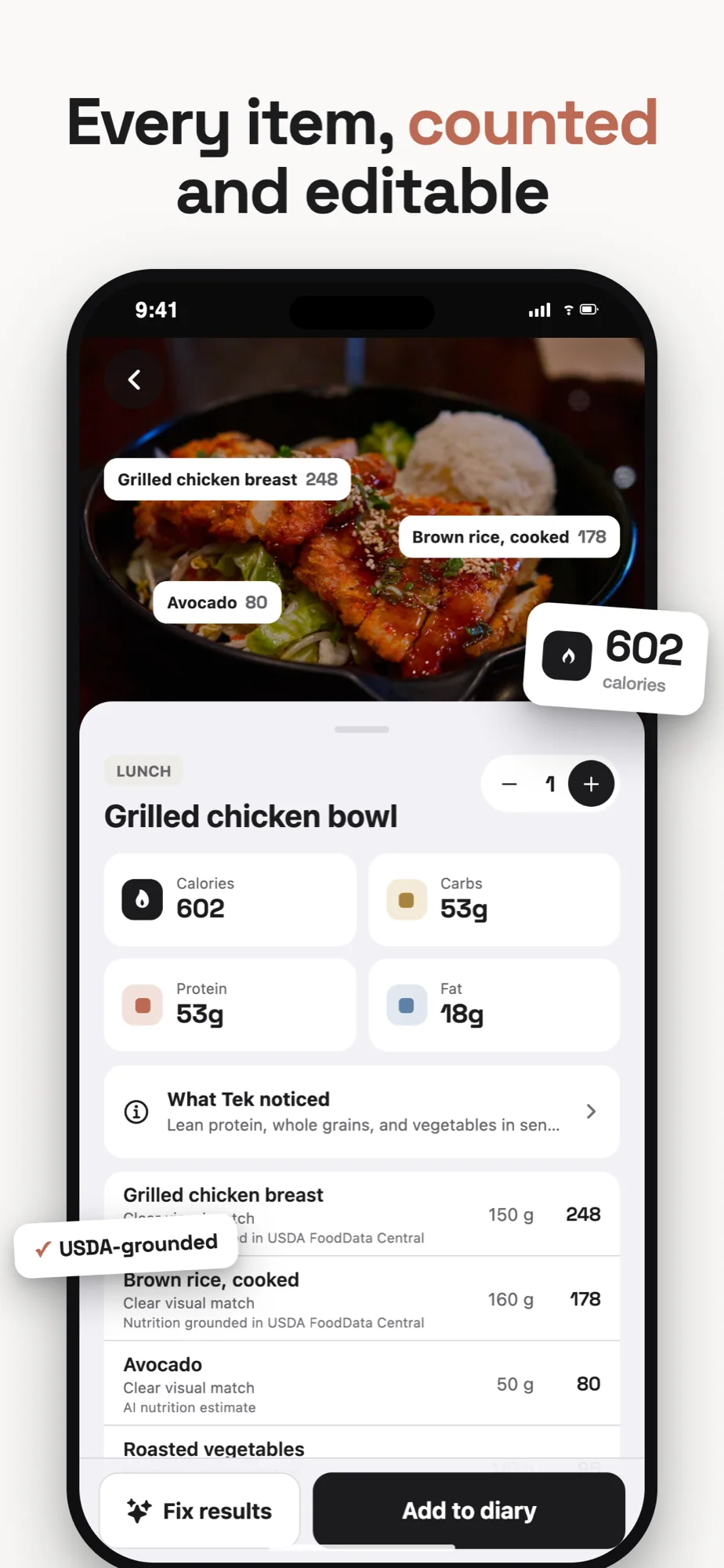
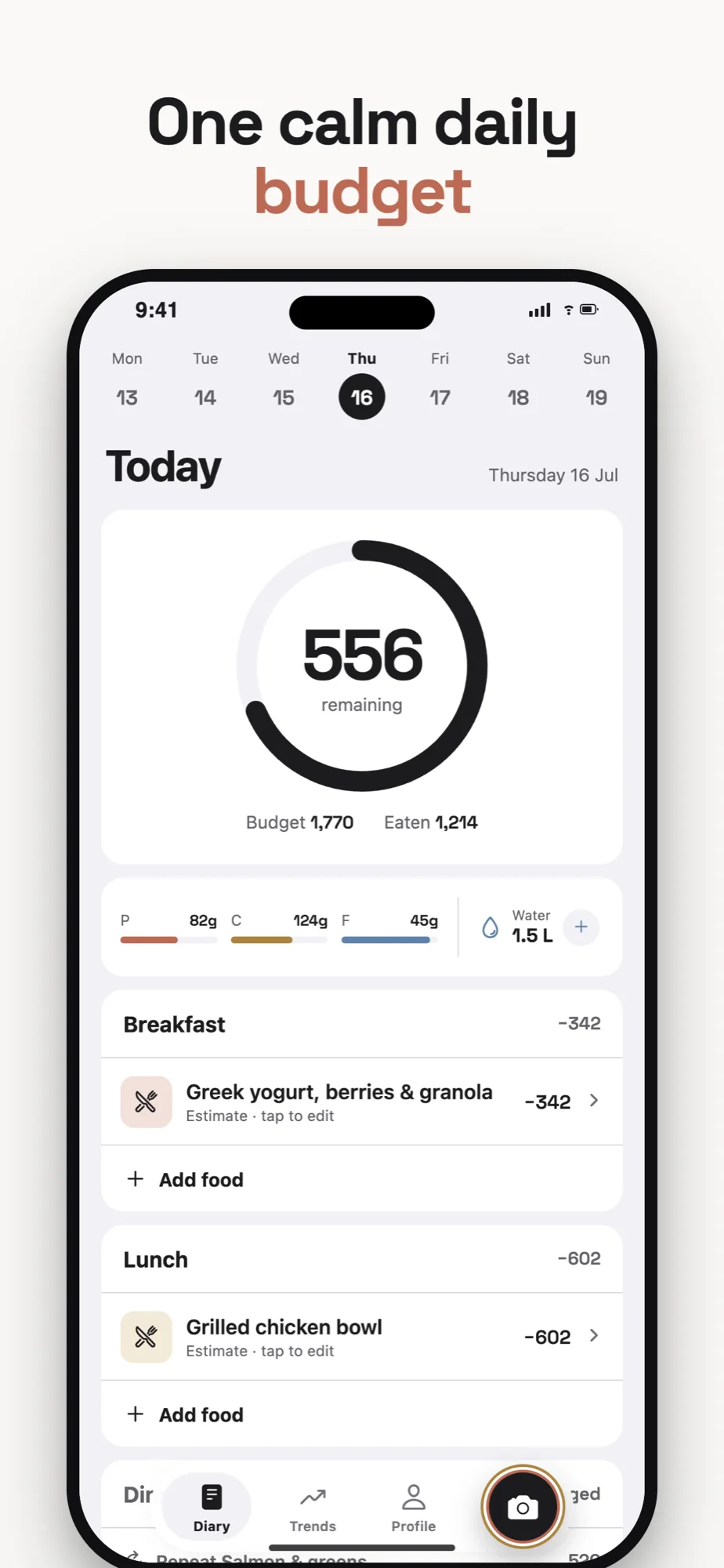
When the budget lives somewhere you actually look, the deficit stops being a vague intention and becomes a series of small, visible decisions across the day.
Judge progress by the trend, not the morning
Bodyweight swings from day to day for reasons that have nothing to do with fat. Water, sodium, carbohydrate stores, and even a heavy meal the night before can move the number by a kilogram or more. None of that is fat gained or lost.
If you weigh yourself and react to every wobble, a normal week can feel like failure. The fix is to zoom out. Weigh in regularly, then watch the direction over two or three weeks rather than any single reading.
This is also why a good plan waits before changing your target. Tek does not nudge your budget on a single bad or good day. It waits for several weigh-ins across a couple of weeks, caps any suggested change to a small amount, and leaves the decision to apply it up to you. A deficit that reacts to noise is a deficit that never settles.
A simple way to set your number today
You do not need a perfect calculation to start. You need a reasonable one and a willingness to adjust.
- Estimate maintenance. Use a Mifflin-St Jeor based calculator, honestly picking the activity level that matches a normal week, not your best one.
- Choose a pace you can keep. For most people, a cut of around 500 calories a day, aiming near half a kilogram a week, is a sustainable starting point.
- Set a floor. Do not drop below a sensible minimum. Very low budgets rarely last.
- Prioritize protein. Aim for a protein target that supports muscle, then fill the rest with foods you enjoy.
- Track for two to three weeks. Log consistently, then look at the trend.
- Adjust once, gently. If the trend has genuinely stalled, trim a little more or add some movement. Do not overhaul everything at once.
The goal is not a flawless spreadsheet. It is a budget that is roughly right, easy to follow, and honest enough to correct when reality disagrees.
The practical answer
How many calories should you eat to lose weight? Start from what your body burns, subtract a modest amount you can sustain, keep protein up, and judge yourself on the multi-week trend rather than the daily number.
A calorie deficit is simple arithmetic wrapped around a hard human problem: doing the same reasonable thing for long enough to see it work. The math is not the obstacle. Staying with it is.
That is the part software can actually help with. Set a budget you can live with, make each meal quick to log, keep the number in front of you, and let the trend, not any single day, tell you how it is going.
Frequently asked questions
How many calories should I eat to lose weight?
Estimate your maintenance calories, the amount your body burns in a day, then eat below that. A deficit of around 500 calories per day is a common, sustainable target that points toward roughly half a kilogram of loss per week. Your exact number depends on your size, age, sex, and activity.
How do I calculate my maintenance calories?
Estimate your resting burn with an equation like Mifflin-St Jeor, then multiply by an activity factor, roughly 1.2 for a mostly seated day up to about 1.55 for an active one. The result is an estimate, so refine it by tracking your intake against your weight trend over a few weeks.
What is a safe calorie deficit?
For most people, a deficit of about 250 to 550 calories per day is both effective and sustainable. Larger deficits speed things up on paper but are harder to hold and can leave you hungry and low on energy. Avoid very low daily totals; a sensible minimum keeps the plan livable.
Should I eat back the calories I burn from exercise?
Generally no. Exercise-calorie estimates are often too high, and eating them back can erase your deficit. It is usually better to account for activity when you set your budget and then keep that budget steady, rather than earning and spending extra calories per workout.
Do macros matter for weight loss?
Total calories drive weight loss, and studies comparing different macronutrient ratios show similar results when calories are matched. Macros still help with comfort and body composition: enough protein preserves muscle and curbs hunger, while the fat-to-carb balance is mostly personal preference.
Why has my weight loss stalled?
Often the scale is reacting to water, sodium, or normal daily swings rather than stalled fat loss, so check the multi-week trend first. Real plateaus also happen because a lighter body burns fewer calories, so the same deficit does less over time. If the trend has truly flattened, make one small adjustment and give it a couple of weeks.