How to Calculate Calories in a Recipe: Weigh the Pot, Not the Servings
Add up the raw ingredients, weigh the finished dish, and divide by what is actually on your plate. A step-by-step method, a worked example, and the mistakes that quietly throw the number off.
The recipe card says it serves four. Your bowl has no idea.
That gap is where most of the error in home-cooked calorie counts lives. People do the hard part carefully, adding up every ingredient, then split the result by a number printed at the bottom of a recipe and ladle out portions by eye. The total is right. The serving is a guess.
There is a better divisor than servings: the weight of the finished dish. Add up what went into the pot, weigh what came out, and you have a calories-per-gram figure that works for any portion you serve yourself, on any day, from the same batch. It is the same method food composition databases use for mixed dishes, and it takes one extra minute and a kitchen scale.
The short answer
To calculate the calories in a recipe:
- Weigh every ingredient raw, including the oil and butter you cook with.
- Look up calories for each ingredient from a reliable source, using the raw entry, and add them up for a whole-recipe total.
- Weigh the finished dish. Subtract the weight of the pot or pan.
- Divide the total calories by the cooked weight to get calories per gram, then multiply by the weight of your portion.
Our free recipe calorie calculator handles steps one and two with USDA FoodData Central data and gives you macros alongside calories. The rest of this guide explains why each step matters, works through a real example, and covers the mistakes that throw the number off.
Step 1: Weigh ingredients raw
Use a kitchen scale and grams wherever you can. Volume measures are where home recipes lose their accuracy first. In one study of portion estimation, only 29% of estimates made in cups and spoons landed within 25% of the true weight. Even the spoon itself is not a standard unit: teaspoons and tablespoons collected from 25 households held anywhere from 2.5 to 7.3 millilitres.
Then match each weight to the right entry. A raw weight needs a raw entry. Cooking changes how much water a food holds, which changes its weight without changing its calories, so the same piece of food has two very different numbers per 100 grams depending on when you weigh it.
The same effect runs the other way for anything that absorbs water. USDA FoodData Central lists dry pasta at 371 calories per 100 grams and cooked pasta at 158. White rice goes from 365 raw to 130 cooked. Weigh 250 grams of cooked spaghetti and log it against the dry entry, and you record 928 calories for a plate that holds about 395.
Raw is the better default for two reasons. Raw weights are what packaging and most recipes give you, and raw entries do not depend on how long you cooked something or how much water it took on. If all you have is a cooked weight, use a cooked entry rather than converting in your head.
Watch the form of canned and packaged foods too. Canned kidney beans are 124 calories per 100 grams drained and 81 with their liquid, because the liquid is mostly water. Pick the entry that matches what actually went into the pot.
Step 2: Add everything, especially the fat
The ingredients you remember are the ones you bought for the recipe. The ones you forget are the ones already in the kitchen: the oil in the pan, the butter stirred in at the end, the splash of cream, the handful of cheese on top.
Those are also the densest things in the dish. Olive oil is 884 calories per 100 grams, so a single tablespoon is about 119 calories and a teaspoon about 40. Onions are 40 per 100 grams. Leave out the vegetables and your total barely moves. Leave out the oil and it can move by hundreds.
And dishes can carry a lot of it. An analysis of 302 standard Chinese dishes found an average of 8.1 grams of oil per 100 grams of ingredients, rising to 10.9 grams in meat dishes. At that rate, a kilogram of ingredients goes into the wok with around 80 grams of oil, roughly 700 calories, before anything else is counted.
The fix is mechanical. Pour oil into a measuring spoon rather than straight from the bottle, or put the bottle on the scale before and after and log the difference. The second method is faster than it sounds and catches the second glug you did not plan.
Count the fat that goes in, not only the fat the recipe asked for.
Step 3: Weigh the finished dish
This is the step most people skip.
Simmering drives water off, so a stew usually weighs less than the ingredients that went into it. Pasta bakes and rice dishes do the opposite, soaking up water and getting heavier. Neither change adds or removes calories. It only changes how concentrated they are, which is exactly what you need to know to log a portion.
Food composition databases handle mixed dishes the same way. The EuroFIR guidelines for harmonised recipe calculation, written for European food composition databases, sum the raw ingredients and then adjust for the weight change of the finished dish as a whole: “Weight yields should be applied at recipe level.” Weighing your pot is the home version of that rule.
To make it painless:
- Weigh the empty pot or dish once and write the weight on a strip of tape on its underside. You will never need to weigh it again.
- Weigh it full when the dish is done, and subtract the empty weight.
- Or transfer to a container you have already zeroed on the scale, which is easier when the pot is heavy or hot.
If a scale that holds a full pot is not available, you can weigh the storage containers after you portion into them. The goal is the same: a total cooked weight you can divide by.
Step 4: Divide by weight, not by servings
This is the step that makes the rest worth doing.
Dividing a total by the number of servings assumes the portions are equal. They almost never are. Soups, stews, curries, and casseroles are hard to split evenly, the first bowl out of the pot gets more of the good stuff than the last, and “a quarter of the pan” becomes whatever fits in the bowl you grabbed.
Dividing by weight removes the assumption. Once you know the calories in every 100 grams of the finished dish, the number of servings the recipe claims stops mattering. You weigh your bowl and multiply.
Here is what that looks like with an ordinary pot of chili.
One pot of chili, worked through.
Raw weights in, USDA values per ingredient, then the finished pot on a scale.
- Ground beef, 85% lean, raw500 g1,075
- Olive oil1 tbsp119
- Onion1 large60
- Red bell pepper1 medium31
- Garlic3 cloves13
- Kidney beans, drained2 cans660
- Crushed tomatoes28 oz can254
Then weigh the finished pot
1,850 g cooked
120 cal per 100 g
- A quarter of the pot, by eye
- 553 cal
- Small bowl, 400 g
- 478 cal
- Big bowl, 560 g
- 670 cal
The whole pot comes to 2,212 calories, which is the easy part. Divided by the four servings the recipe promises, that is 553 a bowl. But the pot weighs 1,850 grams after simmering, so every 100 grams carries about 120 calories, and the bowl you actually serve yourself decides the rest. A 400-gram bowl is 478 calories. A 560-gram bowl, the kind you pour when you are hungry, is 670.
That is a 192-calorie spread between two bowls from the same pot, both of which would have been logged as “one serving.” Eat the big bowl four times a week, log it as a quarter of the pot each time, and about 470 calories a week go unrecorded, from a recipe you counted carefully.
Notice too where the calories sit. The beef and the beans carry nearly four-fifths of the pot. The single tablespoon of oil, highlighted, is 119 calories on its own, more than the onion, pepper, and garlic combined.
Does cooking change the calories?
Not in the way people usually worry about. Heat does not burn calories out of food in any amount that matters for tracking. A review of how frying affects nutrients found little or no impact on protein, and the losses USDA tracks in its retention tables are vitamins and minerals, not energy.
What cooking does change is the three things the method above already handles:
- Water. Lost to evaporation or absorbed from the pot. It moves the weight, not the calories, which is why you weigh the finished dish.
- Fat added. Anything fried or sautéed takes up some of the fat it cooks in. Weighing the oil you use covers this, since you are counting what went into the pan.
- Fat removed. Drain the fat from browned mince or roast meat and pour it away, and those calories leave the dish.
That last one is the only case where a raw-weight calculation overshoots. If you routinely drain fat, you have two options. Accept the raw figure as a small, conservative overestimate, or weigh the meat after browning and draining and log it against a cooked, drained entry instead. Both are reasonable. The first is simpler, and for lean meat the difference is small.
The mistakes that move the number most
Roughly in order of how many calories they tend to hide:
- Leaving out the cooking fat. One unlogged tablespoon of oil is about 119 calories spread across the pot. Two or three is a meal’s worth.
- Mixing raw weights and cooked entries. Logging cooked pasta against the dry entry more than doubles it. Logging raw chicken breast against a roasted entry inflates it by more than a third. The error runs in whichever direction the mismatch points.
- Dividing by servings instead of weight. As the chili above shows, two “servings” from the same pot can differ by close to 200 calories.
- Forgetting what goes on at the table. A 28-gram handful of cheddar is 113 calories. Sour cream, a drizzle of oil, and a slice of buttered bread are all outside the pot and all real.
- Picking the wrong form of an ingredient. Drained or undrained, with skin or without, dry or cooked, regular or reduced fat. The name matches; the numbers do not.
- Scooping instead of weighing. Cups and spoons are fine for things that barely register, like spices, stock, and chopped vegetables. They are a poor way to measure flour, nut butter, oil, cheese, and rice.
Fix the first three and you have captured most of what separates a careful recipe calculation from a rough one.
How accurate is a recipe calculation?
Good enough to trust, not precise enough to argue with.
Ingredients vary. One pack of 85% lean beef is not identical to the next, a large onion is a range rather than a size, and database values are averages of samples. A weighed recipe calculation will not match a lab analysis to the calorie. Neither, it is worth knowing, does the label on a packaged meal.
The point of weighing is not perfection. It is removing the large, one-directional errors: the forgotten oil, the raw-versus-cooked mix-up, the bowl that was secretly a third bigger than a serving. Those are the mistakes that add up week after week. The small, random ones, a slightly bigger onion here and a leaner pack of mince there, tend to wash out.
Compare that with estimating a finished dish by eye. In a 1982 study of dieters’ food estimates, guesses at the calories in ten common foods were off by an average of 53%. A weighed recipe will not be perfect, but it will not be that.
It also helps to keep the bigger picture in view. Cooking at home is already on your side. In US national survey data, adults in households that cooked dinner six or seven nights a week ate about 2,164 calories a day, against about 2,301 in households that cooked once a week or less, and got far fewer of their calories from food prepared away from home. That is an association rather than proof of cause, but it points the same way as everything above: food you made yourself is food you can actually know the numbers for.
Logging it without redoing the math
The point of doing this once is that you never do it again for the same dish.
Write the calories per 100 grams on the lid of the container, or in the notes of the recipe. Next time you make it the same way, the number carries over. If you change something big, swap the beef for turkey or double the oil, recalculate. Small changes to the vegetables will not move it enough to matter.
From there, logging a portion is weigh, multiply, done. In Tek, manual entry takes calories, portion weight, and macros directly, and anything you log once can be repeated from your recent meals the next time you eat from the same batch. For a dish you did not cook yourself, or one where the recipe is long gone, a photo or a typed description gets you an editable estimate instead. The two methods are complementary: the recipe calculation is the more accurate one whenever you have the ingredients in front of you, and the camera covers everything else.
Designed for correction, not blind trust
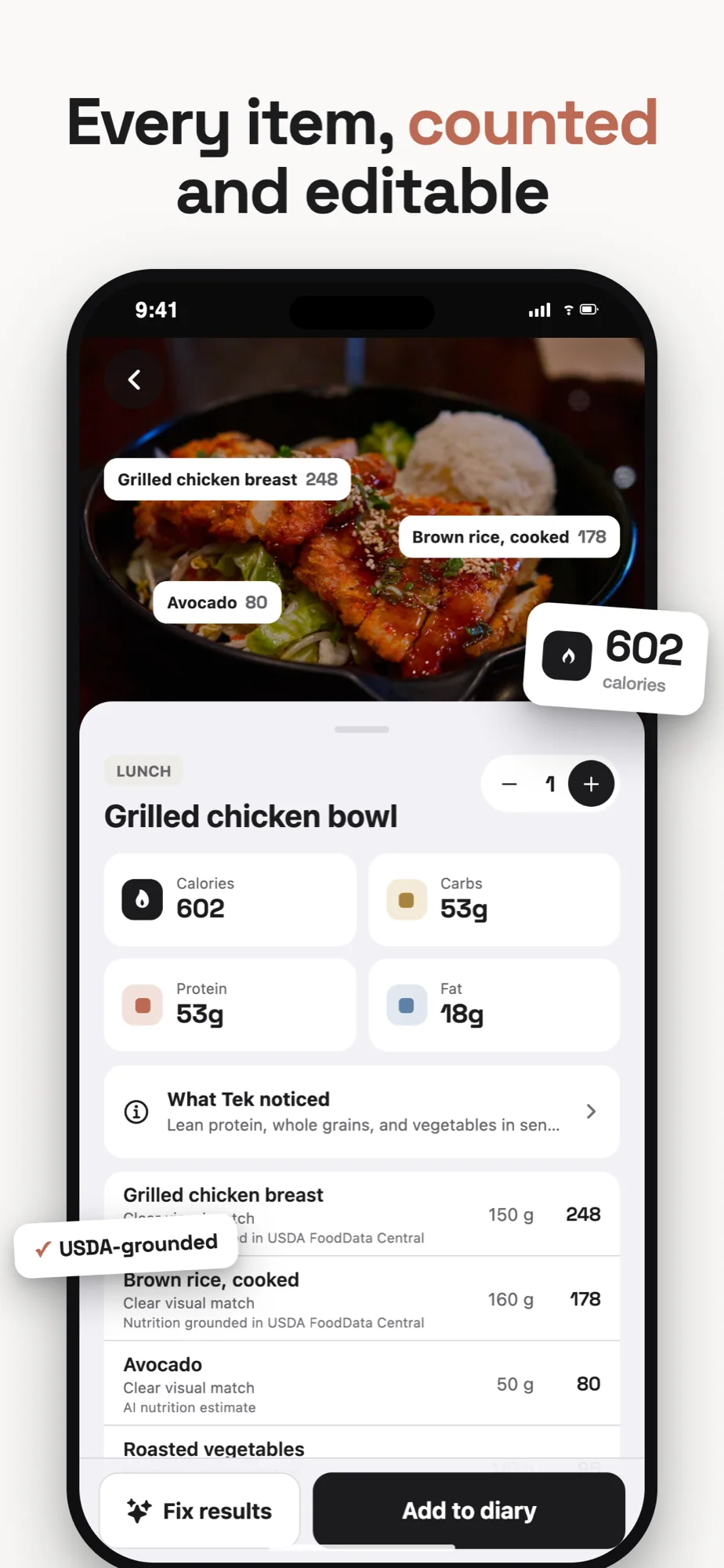
Tek shows the foods behind the number.
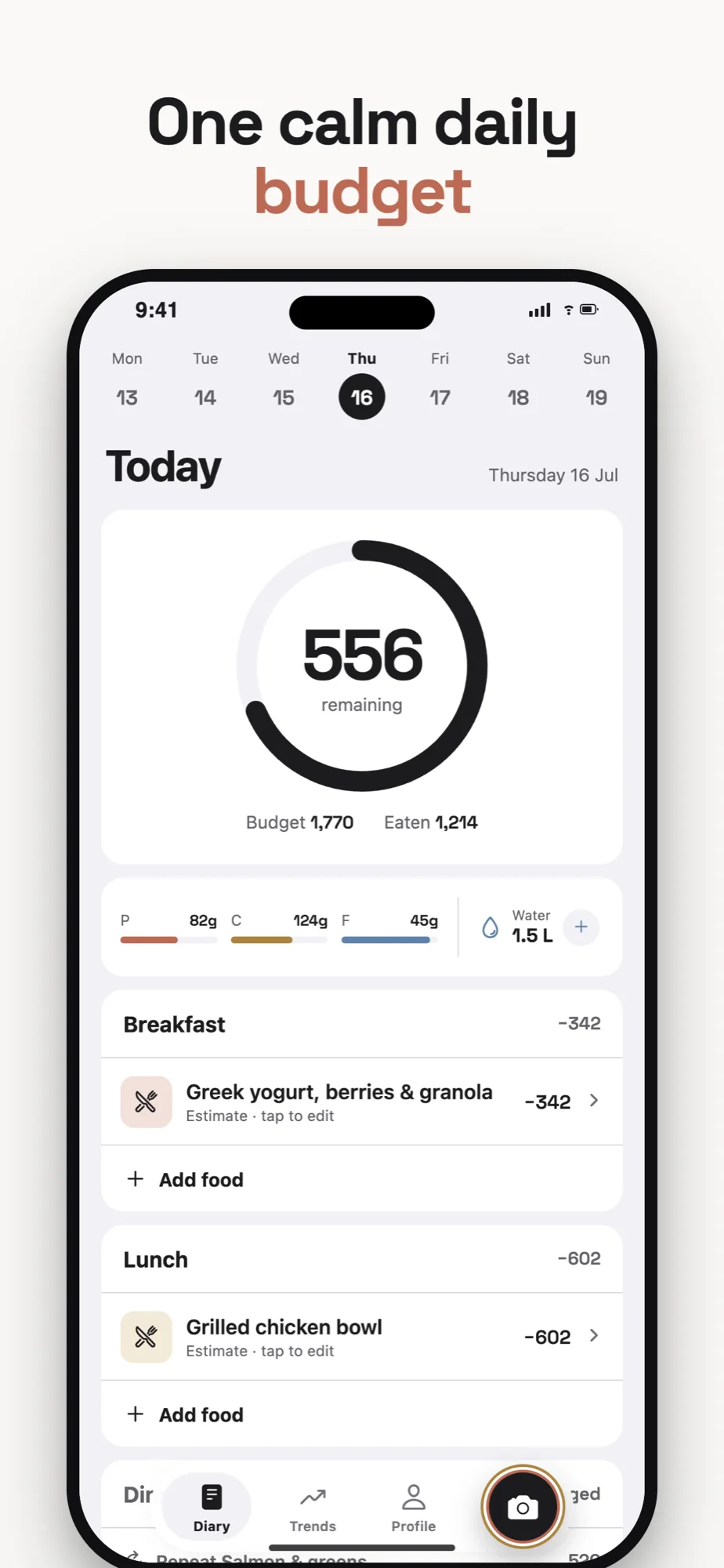
Review each item, change a portion, add a missing sauce, then return to one calm daily budget. The estimate starts the log. You finish it.
- Itemized foods and portions
- USDA grounding when available
- Plain-language fixes
- Every estimate stays editable
Frequently asked questions
How do you figure out the calories in a recipe?
Weigh every ingredient raw, look up the calories for each one, and add them up for a whole-recipe total. Then weigh the finished dish and divide the total by that cooked weight to get calories per gram. Multiply by the weight of your portion and you have the calories on your plate, however big or small it is.
How do I work out calories per serving of a homemade meal?
Dividing the total by the number of servings works only if every portion is identical, which is rare with soups, stews, and casseroles. It is more accurate to divide the total by the cooked weight of the dish and then weigh each serving. If you do divide by servings, portion the whole batch into containers at once and weigh them so the servings are genuinely equal.
Should I weigh ingredients raw or cooked?
Raw, with raw entries to match. Cooking changes water content, so a food's calories per 100 grams can more than double or fall by half depending on when you weigh it. Dry pasta is 371 calories per 100 grams and cooked pasta is 158. If you only have a cooked weight, use a cooked entry instead of converting in your head.
Does cooking change the calories in food?
Not meaningfully. What changes is weight, through water lost or absorbed, and fat, through oil taken up in the pan or rendered fat poured away. Weighing the oil you use and weighing the finished dish accounts for both. The only common case where a raw calculation overshoots is when you drain off fat, and then the raw figure is a small, conservative overestimate.
Do I need to count the oil I cook with?
Yes. It is usually the single most calorie-dense ingredient in the pot. A tablespoon of olive oil is about 119 calories, more than a large onion, a pepper, and several cloves of garlic combined. Measure it with a spoon, or weigh the bottle before and after cooking and log the difference.
What if I do not know what went into the dish?
A recipe calculation needs the ingredients, so for food someone else cooked, a restaurant meal, or a dish where the recipe is long gone, an estimate is the realistic option. A photo or a written description can give you an editable starting point. Treat it as a first draft, correct anything you know, and add the fats and sauces the camera cannot see.