Tracking Food on a GLP-1: Aim at the Protein Floor, Not the Calorie Ceiling
A GLP-1 handles the calorie ceiling for you. It does nothing about the protein floor, and most people on one are well under it. Here is what to track instead, and what the body composition research actually shows.
A GLP-1 does the exact thing calorie tracking was invented to do. It makes you eat less without having to decide to.
Which raises a fair question: if the medication is already holding intake down, what is left to track?
The medication manages the ceiling. Nothing in the prescription manages the floor. That inversion is the whole point. Off a GLP-1, the hard part of eating well is stopping. On one, the hard part is getting enough of the few things you genuinely need, on days when food holds no interest at all. Tracking still has a job. It is just not the job it used to have.
The number the medication does not manage
Start with what actually happens to intake once appetite drops.
Read that as a description of a mechanism, not a scolding. When appetite falls by a third, intake does not fall evenly across the plate. Protein is dense, slow, and filling, which are useful properties when you are trying to eat less and unhelpful ones when you can barely finish half a portion. Chicken breast is the first thing to look unappealing. Crackers are the last.
So the deficit takes care of itself, and the composition of what remains quietly degrades. Nobody notices, because the scale is moving and the scale is what everyone is watching.
That is the case for tracking on a GLP-1, and it is a narrower case than the usual one. You are not policing a total. You are checking that a floor got cleared.
What the body composition research actually shows
Before setting a target, it is worth being accurate about the risk, because this topic attracts more alarm than the data supports.
The concern is that weight lost on a GLP-1 comes disproportionately from lean tissue. The headline numbers look bad in isolation.
Taken alone that sounds like an argument against the drugs. It is not, for three reasons that rarely make it into the headline.
The first is the comparison group. In the tirzepatide substudy of SURMOUNT-1, 255 participants were enrolled and 160 completed scans at both baseline and week 72, and about 75% of the weight lost was fat against 25% lean. The same split showed up in the placebo group. People losing weight without the drug lost lean tissue in the same proportion as people losing weight on it. The same is true of ordinary dieting: the proportions in the semaglutide analysis were in line with what low-calorie, low-carbohydrate, and low-fat diets have produced for decades. Losing weight costs some lean tissue. That is a property of weight loss, not of the medication.
The second is that lean mass is not muscle. A DXA scan sorts your body into fat, bone, and everything else, and everything else includes water, glycogen, connective tissue, and organs. Glycogen loading alone shifts measured lean mass by around 2%, and drinking a litre of water can add more than a kilogram to the reading. When you eat less, you carry less glycogen and less of the water bound to it, and your digestive tract holds less food at any moment. All of that lands in the lean column. Some real muscle is in there too. It is not the whole number.
The third is that function often moves the other way.
A group that lost lean mass on paper got stronger in practice, and ended up with a better ratio of lean mass to bodyweight than it started with. That is the outcome that matters, and it is the opposite of muscle wasting.
So the honest summary is this. The panic about GLP-1s and muscle is overstated. The practical problem underneath it is real anyway. You are unlikely to be melting muscle because of the drug. You are quite likely to be eating half the protein your body would prefer, and that is a variable you control.
The number to aim at
For preserving lean mass during weight loss, the range that keeps appearing across the literature is 1.2 to 1.6 grams of protein per kilogram of bodyweight per day.
Some context on the upper end. A 2018 meta-analysis of protein and resistance training found the benefit to muscle mass flattened out at around 1.6 g/kg, which is where that number comes from. Above it, more protein did not buy more muscle in the pooled data. Trained people in an aggressive deficit may do better higher, but for most people on a GLP-1 the relevant problem is being at 0.8, not choosing between 1.6 and 2.2.
For a rough target: multiply your weight in kilograms by 1.2 for a floor, and by 1.6 for a comfortable ceiling. At 90 kg that is 108 to 144 grams a day. If you carry a lot of excess weight, calculating on a target or adjusted bodyweight rather than your current one gives a more sensible figure, and is worth asking your prescriber or dietitian about.
Then split it. Somewhere around 25 to 35 grams per eating occasion is the usual advice, which on a GLP-1 runs straight into the obvious problem: you may not be able to eat 30 grams of protein in one sitting any more. That is a scheduling problem rather than a target problem, and the fix is more occasions rather than bigger ones.
If you also want a calorie number to sit underneath the protein target, our guide to how many calories to lose weight covers estimating maintenance and choosing a deficit, and the calorie deficit calculator will do the arithmetic. On a GLP-1 the calorie figure is usually a sanity check rather than a rule to enforce, for a reason worth spelling out: your appetite is already producing a deficit, and stacking a deliberate one on top is how people end up under-eating badly.
Why tracking gets harder, not easier
There is an assumption that eating less makes logging easier. Less food, fewer entries, less work.
On a GLP-1 the opposite tends to happen, and it catches people out.
Meals fragment. A dinner you would once have eaten in one sitting becomes a third of a portion at seven and the rest at nine, if it gets finished at all. Half a protein shake in the morning, a few bites of leftovers, a yoghurt before bed. The number of separate eating events per day goes up even as total intake goes down, so the logging burden per calorie roughly doubles.
Then the recall problem gets worse. Traditional tracking leans on the fact that meals are memorable events. Grazing on small amounts across a day is exactly the pattern people are worst at reconstructing afterwards, and the food most likely to be forgotten is the small, unplanned, low-protein kind.
And the motivation that normally sustains tracking is gone. Logging is tedious, and people put up with it because it stops them eating too much. When the medication has already stopped that, the daily reason to open the app disappears while the nutritional reason to open it is at its strongest.
This is the practical argument for making the act of logging as close to free as possible. A method that takes forty seconds of database searching per item will not survive six small eating events a day when you are also faintly nauseated. A photo, or a spoken sentence, might.
The good news about estimating these meals
If you do log by photo, GLP-1 eating happens to sit on the friendly end of the accuracy range.
What the camera can see matters.
The same scanner can be useful on one plate and badly under-informed on the next.
Fruit
Eggs and toast
Separated plates
Packaged food
Photo estimation struggles most with hidden fats, sauces, mixed dishes, and restaurant portions, where the calories are invisible and the errors run in one direction. It does best with plain, separable, protein-dense food: eggs, grilled chicken, fish, Greek yoghurt, cottage cheese, tofu, a protein shake.
That list is close to a description of what people actually eat on a GLP-1. Rich and fatty foods tend to be poorly tolerated and get dropped without much effort, which removes the hardest cases from your diary. The meals that remain are the ones a scanner reads most reliably. We covered where those estimates hold up and where they break down in can a photo really count calories.
Protein is also the macro estimation handles best, because it comes mostly from identifiable items in visible portions rather than from an unmeasured pour of oil. If you are going to trust one number from a photo estimate, protein from a plain chicken breast is a better candidate than calories from a curry.
How to run it
- Set a protein floor, not a calorie ceiling. Weight in kilograms times 1.2 is the minimum. Write it down as a daily number to clear, and treat the calorie total as information rather than a limit.
- Log protein first. If you only capture one thing per eating occasion, capture the protein. Missing 40 calories of crackers costs you nothing. Missing whether you hit 60 grams or 110 costs you the only variable you are managing.
- Eat protein when the window is open. Many people find appetite is at its worst in the day or two after a dose and easier later in the week. If that is your pattern, put the protein where you can actually eat it rather than assuming dinner will be available to you.
- Keep a default protein you never have to decide about. A shake, Greek yoghurt, cottage cheese, or eggs in the fridge at all times. On the days you cannot face cooking, the decision is already made.
- Track the worst days, not the average. A weekly average hides the pattern that matters, which is the day after a dose increase when you ate 30 grams total. Those are the days doing the damage, and they are the ones to plan around.
- Add resistance training if you can. Every review of lean mass on these drugs lands on the same two mitigations, and protein is only one of them. Two or three sessions a week is the usual recommendation.
- Re-check the target as you lose weight. Your protein floor is calculated from your bodyweight, so it drifts down as you do. Recalculate every 5 to 10 kg.
When the number matters more than usual
A few situations deserve more attention than a general article can give.
Rapid loss raises the stakes, since the faster the weight comes off the less room there is for the composition of the loss to be casual. Older adults start with less muscle to spare and lose it more readily. And if you are approaching maintenance or planning to come off the medication, the transition is the moment your intake stops being managed for you, which is the same measurement problem we describe in the guide to finding your maintenance calories, with an appetite that may return faster than your habits do.
This article is about what to track and why, not about your dose, your labs, or whether the medication suits you. Persistent inability to eat, dizziness, hair loss, or a sense of weakness are all worth raising with your prescriber rather than solving with a spreadsheet. A registered dietitian is the right person to set a target against your actual body and history.
The short version
A GLP-1 removes the problem that calorie tracking was designed to solve, and leaves a different one in its place.
You no longer need an app to stop you eating. You need one to confirm that the small amount you did eat contained enough protein to hold on to the muscle underneath the weight you are losing. Most people on these medications are not clearing that bar, and almost none of them know it, because nothing about the experience feels like under-eating.
Set the floor. Log the protein. Let the ceiling take care of itself, because it already is.
Designed for correction, not blind trust
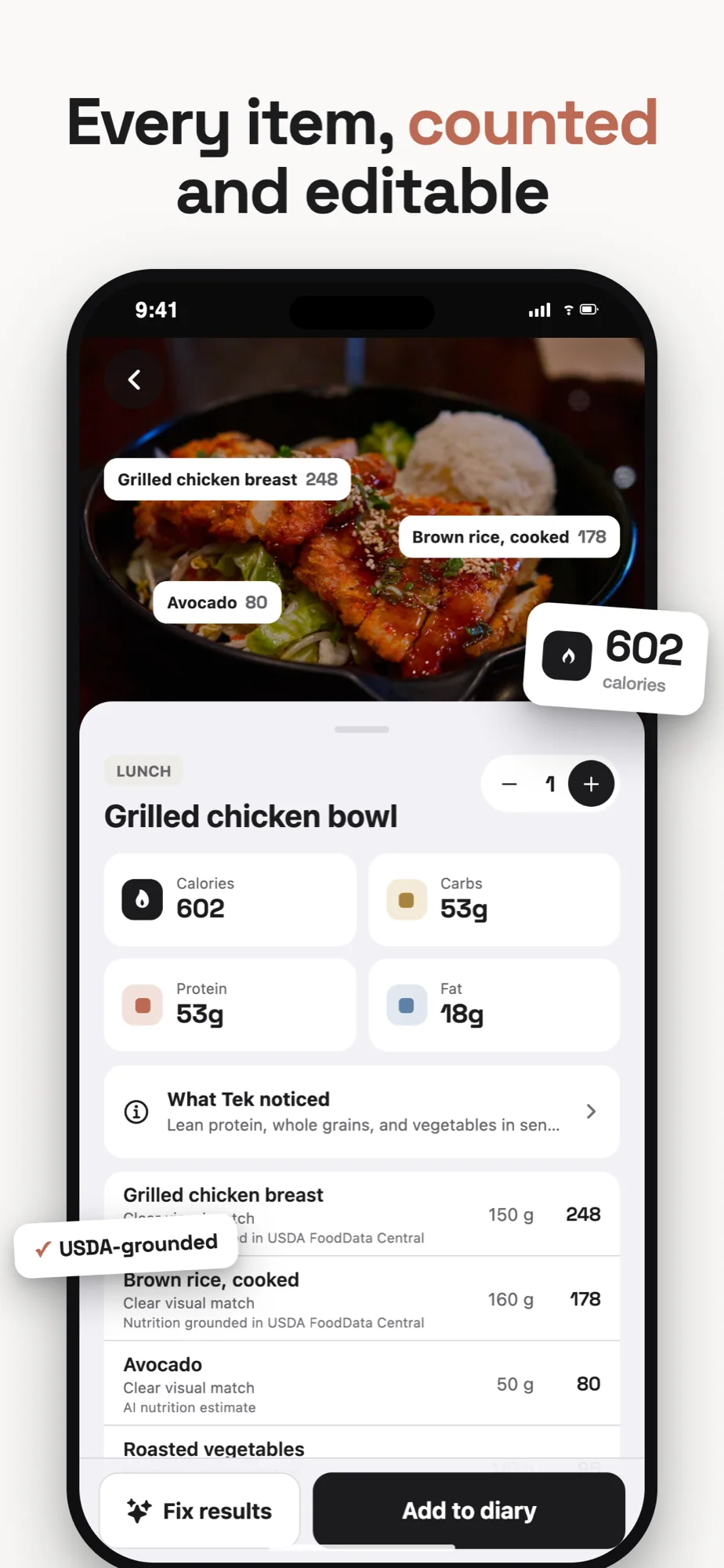
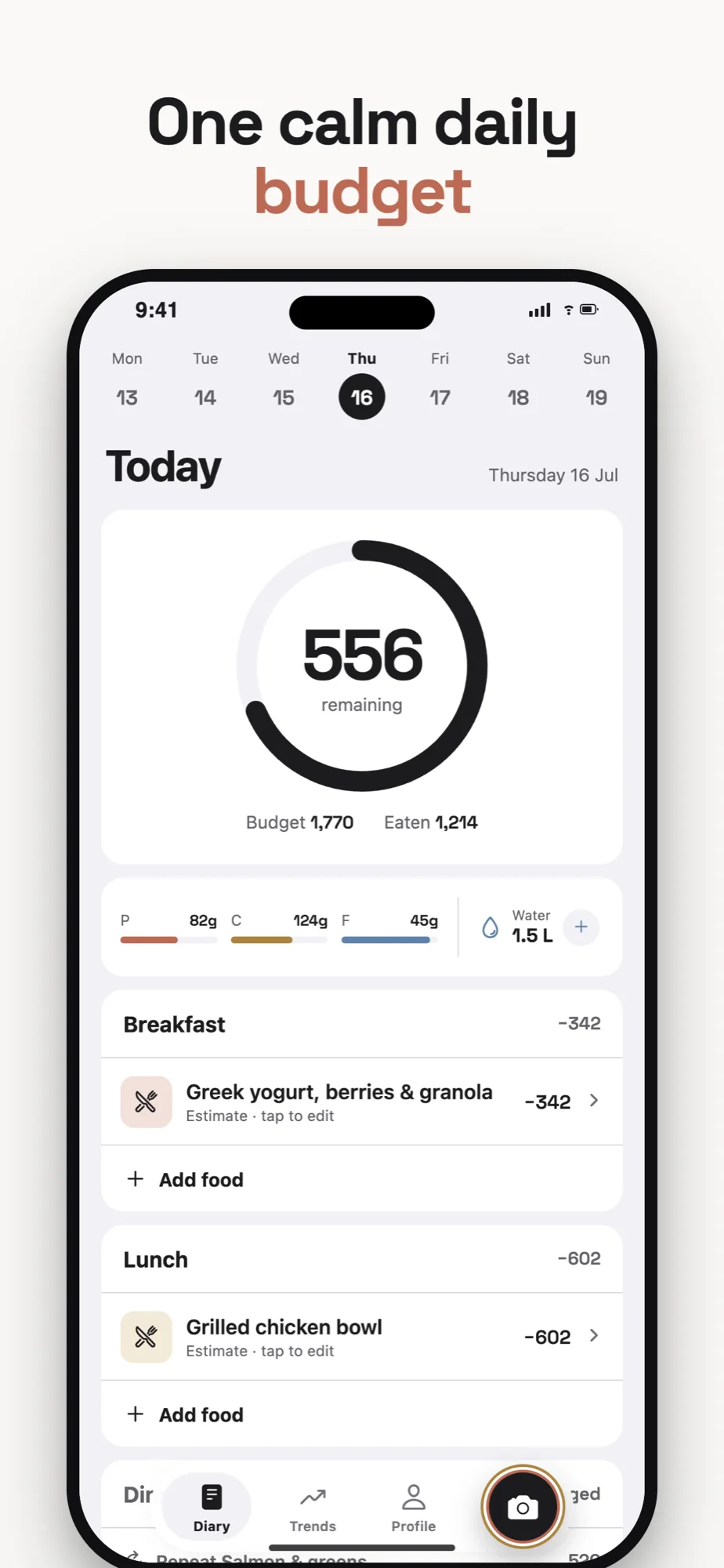
Tek shows the foods behind the number.
Review each item, change a portion, add a missing sauce, then return to one calm daily budget. The estimate starts the log. You finish it.
- Itemized foods and portions
- USDA grounding when available
- Plain-language fixes
- Every estimate stays editable
Frequently asked questions
Should I count calories on a GLP-1?
Usually as a reference rather than a rule. The medication is already producing a deficit, so enforcing a second one on top is the main way people end up under-eating on these drugs. Most people get more from tracking protein daily and glancing at calories weekly, mainly to confirm intake has not fallen dangerously low rather than to keep it down.
How much protein should I eat on a GLP-1?
The range that appears most consistently for preserving lean mass during weight loss is 1.2 to 1.6 grams per kilogram of bodyweight per day, spread across the day in portions of roughly 25 to 35 grams. At 90 kg that is about 108 to 144 grams daily. If you carry a lot of excess weight, calculating from an adjusted or target bodyweight gives a more realistic figure, which is worth confirming with your prescriber or a dietitian.
Do GLP-1 drugs cause muscle loss?
They cause lean mass loss, which is not quite the same thing. Trial data shows roughly 25 to 40% of weight lost coming from the lean compartment, but placebo and diet-alone groups show similar proportions, and that compartment includes water, glycogen, and organ mass alongside muscle. In one 12-month study, lean mass fell while grip strength rose and the share of participants with sarcopenic obesity dropped. The larger risk is not the drug itself but the very low protein intake that often accompanies it.
What if I cannot eat enough protein to hit the target?
Change the schedule before you change the target. More eating occasions of smaller size usually works better than trying to force a full portion, and liquid protein is easier to tolerate than solid food when appetite or nausea is bad. Fortifying what you already eat also helps, for instance stirring protein powder or Greek yoghurt into things rather than adding another meal. If you are consistently unable to eat, that is a conversation with your prescriber about dosing, not a tracking problem.
Is photo-based tracking accurate enough for this?
For protein from plain, separable foods, generally yes. Photo estimates struggle most with hidden fats, sauces, and mixed restaurant dishes, and do best on the eggs, yoghurt, grilled meat, and fish that make up much of what people eat comfortably on a GLP-1. Treat any estimate as a first draft you correct rather than a measurement, and use barcodes or published nutrition data whenever the real numbers exist.
Should I keep tracking after I stop the medication?
That is arguably the most valuable time to do it. Appetite returns while intake habits are still calibrated to a suppressed one, and the gap between the two is where regain happens. A few weeks of tracking through the transition tells you what your intake is actually doing, which is information no calculator can supply.